


 maibank
 maib business app
 new internet banking - maib business
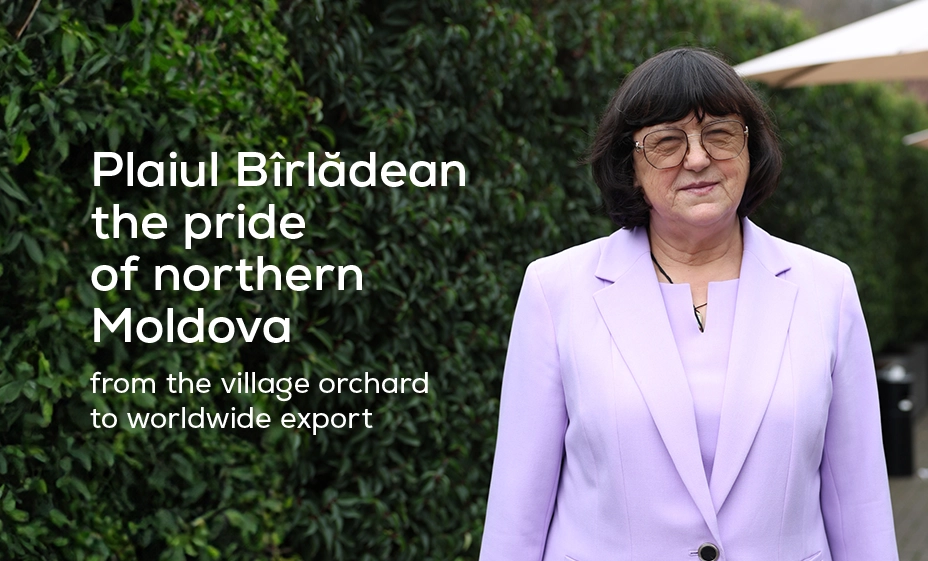
Pavel Zingan in an interview with Tatiana Pavliuc, the owner of “Plaiul Bîrlădean, maib business customer.
“Plaiul Bîrlădean” is one of the best-known fruit-growing enterprises in northern Moldova. Built step by step after the dissolution of the collective farms, the company led by Tatiana Pavliuc now manages over 200 hectares of orchards and exports fruit to markets in Romania, Germany, and even Dubai. In this interview, Tatiana Pavliuc talks about her beginnings, investments, and the current challenges in agriculture.
Tatiana, if you had to describe your childhood through a single fruit, which one would it be, and why?
It would be the apple. My father worked as a tractor driver and always brought home apples of a variety we used to call “white champagne.” They were yellow, beautiful, very tasty, and fragrant. Their flavor and aroma have stayed with me, always reminding me of my childhood.
Is your company a family business, passed down from generation to generation?
No, my father was a tractor driver. I came to Bîrlădeni in 1981 and got a job as a chief economist. I got married in 1980 — my husband is originally from this village — and since 1981, I’ve been working here.
How did the story of “Plaiul Bîrlădean” begin?
After the dissolution of the collective farm, the villagers elected me as the leader — that’s what the position was called back then. For the first year, we worked practically without registration, without a stamp, until the privatization process was completed. On February 14, 1999, we officially registered as “Plaiul Bîrlădean.” We started with about 700 hectares, and today the farm manages around 1,500 hectares, including land from several nearby villages.
Why did you choose to invest so much in orchards?
This village has always had a strong fruit-growing tradition. The collective farm here used to be one of the largest in the district — maybe even in the whole republic. It had over 500 hectares of orchards, fruit processing facilities, and we made preserves that were exported abroad. When I took over, we planted apple, plum, pear, apricot, sour cherry, and cherry trees. I really wanted the kindergartens in the village to have fresh fruit — we supplied everything, since the local administration couldn’t help.
Over time, we kept moving forward. We started with traditional orchards, then, in 2010, added a few dozen more hectares. In 2018, we decided to switch to super-intensive orchards, using the Italian system: 3,500 trees per hectare, anti-hail nets, irrigation — all materials and equipment imported from Italy. At first, it seemed very expensive. But then an Italian agronomist, Angelo, took a handful of our soil, smelled it, and said: “This is the kind of soil we use for potted flowers. It’s wonderful.” That convinced me. So we planted the first modern orchard, and then continued expanding — 25.5 hectares in 2018, another 8.5 in 2019, 20.5 hectares in 2020 through the “Livada Moldovei” program, 17 in 2022, and 22 in 2023.
What is the difference between a traditional orchard and a modern one?
In a traditional orchard, everything depended on rainfall. If there was drought, the fruits stayed small. In modern orchards, we have an irrigation system, and the grass and clover between the rows protect the soil from erosion. Moreover, we can enter the orchard even right after it rains. The mown clover stays on the ground as a natural fertilizer. On one hectare, we plant several times more trees than before, and harvesting is much more efficient — we use platforms and containers, which significantly increases productivity.
What are the biggest challenges you’re facing today?
Water and workforce. We have the equipment, we have the technology — but we don’t have enough water. The state promised a project with pipelines from the Prut and the Nistru rivers, but it hasn’t reached us yet. We’ve prepared all the documents for a $500,000 project, but without the main pipeline, we can’t irrigate properly.
Another major challenge is the lack of workers. Many young people have left the country, and mostly older people remain. For plum harvesting, for instance, it’s a real struggle to find laborers. We provide good conditions — a canteen, transport, and housing for workers — but there simply aren’t enough people. We’re now considering bringing in seasonal workers from Nepal, about 40–50 people, to help during the peak harvest period.
What are you most proud of?
I’m proud that we’ve managed to modernize the entire farm. We now have computerized machinery, solar panels that greatly reduce costs, and digital systems that allow me to see at any time where each tractor is, what it’s doing, and how much fuel it’s using. We have a modern cold storage facility, a sorting line, and we work with high-quality equipment. And, of course, I’m proud of the people from our village who have stayed with us — accountants, engineers, young specialists who studied and now work here.
Where do your fruits end up?
Mainly for export. Our apples go to Romania, plums to Germany, and sometimes even to Dubai. In Moldova, we sell very little — just small batches on the local market. But we regularly donate fresh fruit to schools and kindergartens.
What does it mean to be a woman entrepreneur in agriculture?
It means always staying one step ahead. I can’t stay at home on Sundays — I go to the orchard. I work for the people, so they receive their lease payments, salaries, and decent working conditions. I’ve invested in roads, the school, the kindergarten, gas supply, and telephone services. When the village moves forward, we all move forward together.
What advice would you give to someone who wants to start a business in a village?
Don’t be afraid. Learn, seek information, and talk to those who have already gone through it. There are associations, seminars, and support programs. You don’t have to reinvent the wheel — you learn and take action. If needed, take a loan, work hard, and repay it. That’s how we did it, enjoying the constant support of maib. That’s how a business is built.
What do you feel when you walk through the orchard in the morning?
A person should plant a tree, start a family, and dig a well. I have two sons and eight grandchildren, and I have planted thousands of trees. In the morning, when I enter the orchard, it feels like the trees are speaking to you. They bring you peace. If you come upset from the office, among the trees your worries fade away. At my age, I no longer work for money, but for satisfaction. I love working in the countryside, and as long as I have my health, I will continue.