


 maibank
 maib business app
 new internet banking - maib business
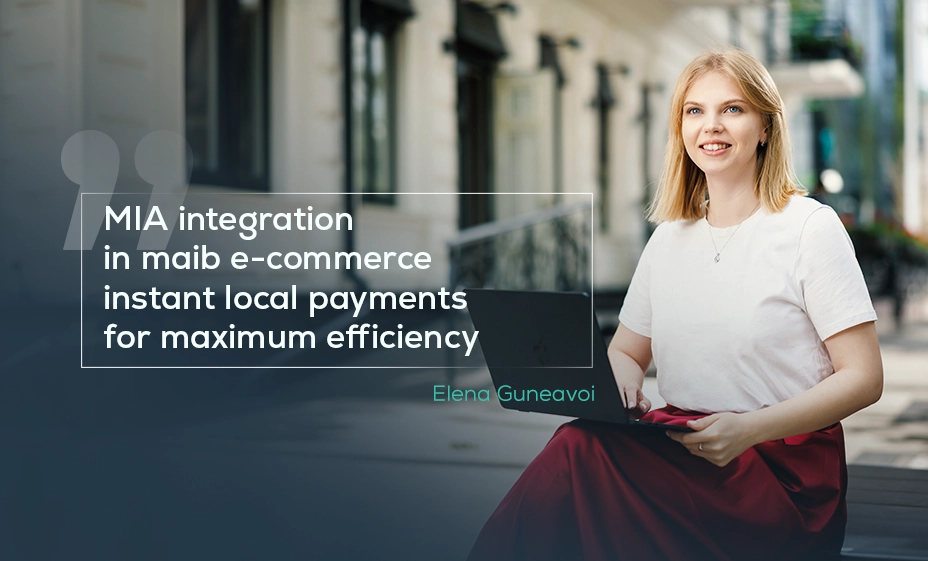
Hello, Elena. As far as transfers between individuals are concerned, the national payment system MIA has already become commonplace. But when it comes to using MIA as a payment method for purchases in stores or online, the topic is still new for both businesses and end users. As Product Manager for Payments at maib, you have an “inside” view of developments in this area. How do you think the integration of MIA into payments between individuals and businesses is progressing?
A platform solution has been available in Moldova for quite some time now, and maib is connected to it. It enables payments via MIA for all acquiring channels, including POS terminals and e-commerce. We actively got involved in this area, but over time it became clear that, as a bank, we would strive to provide this service directly so that the most important aspect – namely, the customer experience – would always remain under our control.
Are you already working on your own solutions?
Given our “digital-first” principle, we first began considering the integration of MIA for e-commerce over a year ago. At the time, the platform solution already existed, was operational, and continues to function.
But as a bank, we decided to go further and came to a simple conclusion. Ultimately, it doesn’t matter to the customer exactly which technology the payment goes through – whether it’s a card, MIA, or something else. They need a convenient, turnkey solution where all services are available in one place. And our task as a bank is to provide them with exactly that experience.
That’s why active development of our own solution began about a year ago, and as early as December 2025, we started developing a solution specifically tailored for e-commerce.
What exactly were you developing?
We developed a unique, unified solution that combines card payments, token-based payments – that is, Apple Pay and Google Pay – as well as payments via MIA. It was important that all of this work within a single interface, on a single checkout page for the customer.
So this is convenient for both the buyer and the merchant?
Absolutely. It’s a win-win situation for both the buyer and our merchant. That’s because the integration is done just once. The client connects a standard e-commerce package, and integration with MIA is already built into it. Essentially, it’s a classic e-commerce solution, but with MIA already integrated.
We launched the solution in December 2025 and are now actively onboarding clients and offering them this service.
Does this module work specifically on the bank’s side? In other words, for example, I might have my own e-commerce solution or a website on some external platform, and the bank provides a module that integrates with these solutions?
The number of platforms we work with is gradually expanding. First and foremost, we implemented a standard connection via API. What does this mean? If a company has its own development team, it can independently integrate the checkout page using our API. We provide comprehensive documentation and a well-designed test environment for this purpose. It allows you to fully test the entire customer experience – from both the buyer’s and the merchant’s perspectives – including additional scenarios and internal processes, right during the integration phase.
So, basically, I come to you with my online store – which was developed by my team some time ago – and you simply connect me to the service?
Yes. Integrating e-commerce always involves certain costs, primarily for development and integration. For our part, we try to simplify this process as much as possible. At the same time, we’ve ensured that classic e-commerce and e-commerce with MIA integration are fully standardized. In other words, in terms of integration complexity and costs for the business, there’s practically no difference.
Essentially, a merchant goes to their developer and says, “I need to set up e-commerce.” And regardless of whether MIA is involved or only classic card payments, the process remains the same. There are no additional costs for the business specifically due to MIA integration. You need e-commerce in any case, and MIA is already becoming part of it.
So any e-commerce integration with a bank requires roughly the same costs, both in terms of money and time. And the fact that MIA is already included in this solution – is that just an added feature?
Yes, that’s exactly right. It’s an added benefit that we offer as part of our ready-made e-commerce solution.
Going back to the topic of integration for a moment, aside from API connectivity, have you also started working with e-commerce platforms?
Yes. We analysed which solutions and platforms our customers use most frequently and began development based on demand. We also plan to integrate less common platforms, but most likely in later phases.
Currently, for the new checkout solution that includes MIA, we already have integration with WooCommerce and a PHP SDK. We’ve also developed a solution for Tilda and are currently awaiting approval from the platform’s team. First and foremost, we focused on covering the most in-demand scenarios.
And in fact, if a business already has a website up and running, all they need to do is install our plugin, add the necessary “secrets” and settings, and everything starts working on the client side almost immediately.
You mentioned “entering secrets”. What does that mean in practice?
These are unique identifiers that the bank provides to each client upon setup. They link the solution to a specific terminal and merchant. Even though it’s a ready-made plugin solution, it remains tailored to each business thanks to these parameters and access settings.
What advantages does Maib have over other banks specifically in this area?
Maib became the first bank to enable full e-commerce integration with MIA “under the hood.” For the client, this is a single, ready-made solution where all payment methods are already integrated within a single system. We, as a bank, also provide a merchant portal, which is equally important for clients.
As I understand it, the merchant portal is also an important part of the overall solution. Because it’s important for businesses not only to set up e-commerce but also to understand what happens next with payments and clients.
Of course. Until recently, our merchant portal was operating in pilot mode, but now we’re ready to talk about it openly because it’s truly a full-fledged part of our e-commerce solution.
Through the portal, clients can not only manage payments but also generate payment links, including links for MIA. This is especially convenient for businesses that sell not only through their website but also, for example, through social media.
In other words, business owners don’t need to redirect clients to their website every time; they can make arrangements through any convenient channel, quickly generate a link, and accept payment immediately.
At the same time, the portal allows you to track all transaction details – whether a payment was made, exactly when, by which client, and so on. But we’ve gone a step further and added not only payment tools but also advanced analytics.
For example, a business can compare its metrics to the market averages in its niche, understand its position relative to the market, and see its customer retention rate. An entrepreneur can analyse whether they’re getting new customers every time or if there’s a certain percentage of their audience that regularly returns to make purchases.
Today, modern businesses are increasingly data-driven. Companies want to make decisions not only intuitively but also based on analytics, and understand which actions truly bring the greatest benefit and efficiency to the business.
You mentioned that it’s possible to generate a link and send it to a client via any convenient channel. So, for example, can a salesperson create such a link and send it via Telegram?
It’s important to understand that there is no direct integration with Telegram or other social networks, primarily for security reasons. The payment link itself is generated on our end, through the merchant portal. Only after that can the merchant send it to the customer via any convenient communication channel, such as Telegram, Instagram, or email.
So, basically, they just send me a link?
Yes, that’s correct. The client receives a secure link to the maib payment page, which is hosted by the bank.
And when I click on that link, I’m taken directly into the maib system, where I complete the payment?
Yes, exactly.
As I understand it, the first reason why integrating MIA into e-commerce is important for businesses is the favourable commission rate. What is the current rate?
It’s currently 0.7%. This rate has been in effect since January.
Is the 0.8% fee fixed across all business categories, or can large retailers negotiate custom rates, as is common with traditional acquiring?
From a technical standpoint, there are no such limitations. And when it comes to individual commercial terms and negotiations, of course, those are possible.
Ultimately, it depends on the type of business and the merchant category. That said, the vast majority of businesses currently fall under the 0.7% pricing tier. There are also categories that qualify for rates as low as 0.5% or as high as 2.0%.
So there are categories of clients for which separate rates apply?
Yes. For example, these could include schools, public organizations, and other similar categories. Here, it’s not the volume of business that matters, but the status of the organization itself.
It’s important to understand that MIA is regulated by the National Bank of Moldova. Even the upper limit on fees is effectively set by the regulator, so banks cannot freely change these rates. This makes the system as transparent as possible for the market.
That said, we’re open to discussing terms with our clients. Business volume certainly plays a role, as does the number of services the client uses at the bank. For example, there’s a difference between a client who operates solely in e-commerce and one who uses several banking products at once. That’s why we try to find a personalized approach for each client and structure the terms so that it’s beneficial for both parties – the business and the bank.
In terms of statistics, how actively are businesses already adopting MIA through maib?
Currently, nearly every other company is requesting this service. This is largely because MIA is a hot topic these days, and businesses already have a good understanding of the value this solution offers them.
Given our integrated approach, we aim to make this solution a sort of “gold standard” and offer it to every client for whom it’s truly suitable.
That said, of course, there are certain limitations. For example, if we’re talking about a Moldovan business that focuses exclusively on foreign sales, MIA may not be the most suitable tool. A lot also depends on the technical side. For instance, official approval for some plugins – such as the solution for Tilda – has not yet been finalized, so in certain cases we are temporarily unable to offer a ready-made integration. But this will be resolved in the near future.
Overall, our goal is to find the solution that will work most effectively for the client’s specific business model.
Are there any incentive programs to encourage end customers to pay via MIA instead of their usual cards?
I can share some best practices. When a new checkout is set up, clients tend to switch to MIA quite readily because all payment methods are listed on a single page, and people often choose the first option without thinking twice. MIA is usually the top button. This is, of course, beneficial for the merchant.
At the same time, everything can be customized individually. If this option doesn’t suit the business, we can change it on our end.
So one way to encourage this is to prioritize MIA in the list of payment methods?
Yes, that’s right. It really works well and shows a transaction increase of about 10-15%. In other words, some of the clients who land on this page choose MIA specifically.
MIA is simpler for the customer after all. You click, select a bank, and go straight to payment.
With card payments, you have to enter the card number and CVV code. These extra steps can be a hassle for many people. MIA, on the other hand, offers a smoother user experience – you simply navigate between pages without any unnecessary steps or delays.
When it comes to additional incentives, such as cashback, it all depends on the merchant. If a business is willing to offer such bonuses to its customers, we, as a bank, are certainly open to discussing this on a case-by-case basis.
Can cashback be offered even when paying through MIA?
Of course. And here, a lot depends specifically on the business’s own initiative – how much it wants to attract customers and is willing to engage with this audience. We’ve seen various approaches. Some businesses actually offer cashback, others refund a portion of the payment, and still others launch special promotional campaigns within their stores. Strategies can vary. And if a business needs support from the bank, we’re certainly open to such initiatives, because it’s in our best interest as well.
In addition, the National Bank itself is actively helping businesses better understand this tool. They conduct training sessions where they explain how MIA works, what benefits it offers businesses, and how it can be used effectively. If it’s important for a business to cut costs and remain competitive, then it’s certainly worth paying attention to this.
Are there solutions for courier delivery? For example, when an online store’s courier generates a dynamic MIA QR code directly on their smartphone at the time of delivery, completely replacing a physical terminal?
When it comes specifically to courier delivery, there are several possible scenarios. As I mentioned earlier, clients have the possibility to generate MIA QR codes, but access to this feature usually remains with the business, not the courier themselves. That said, payment links are very convenient for such scenarios – the courier can simply send the client a link to complete the payment.
In addition, we have a solution where the terminal essentially runs directly within an Android smartphone. This is particularly convenient for courier services, freelancers, and mobile sales. With this app, you can both accept card payments and process payments via MIA without needing a separate physical terminal.
How are refunds and order cancellations handled through MIA?
We have temporarily disabled automatic refunds for MIA because, from a security standpoint, it’s not the most optimal solution. However, refunds can still be processed manually.
Currently, there are two types of refunds. The first is a same-day refund, for example, if a client immediately cancelled an order or an error occurred. This type of refund can be processed directly through the merchant portal: the client logs in, cancels the relevant transaction, and the money is refunded within the same day.
So the decision to issue a refund rests with the merchant?
Yes. For example, if a client contacts us and says they accidentally paid for an order, the merchant can independently decide to issue a refund without any complicated procedures or conflicts.
The same applies to requests made some time later. The merchant manually cancels the transaction if they deem it necessary. When it comes to disputes and chargeback processes, there are no separate or non-standard protocols; everything follows the standard procedure.
At the same time, in our e-commerce solution, all transactions can be conveniently managed through the merchant portal. You can cancel payments, track transactions, and grant access to employees so they can manage these processes on their end.
I believe that the number of details we’ve discussed best demonstrates the attention maib pays to integrating MIA into e-commerce solutions…
Customer experience shows a growing need to expand payment options through the MIA payment system, and we, as a bank, will continue to develop these capabilities.