


 maibank
 maib business app
 new internet banking - maib business
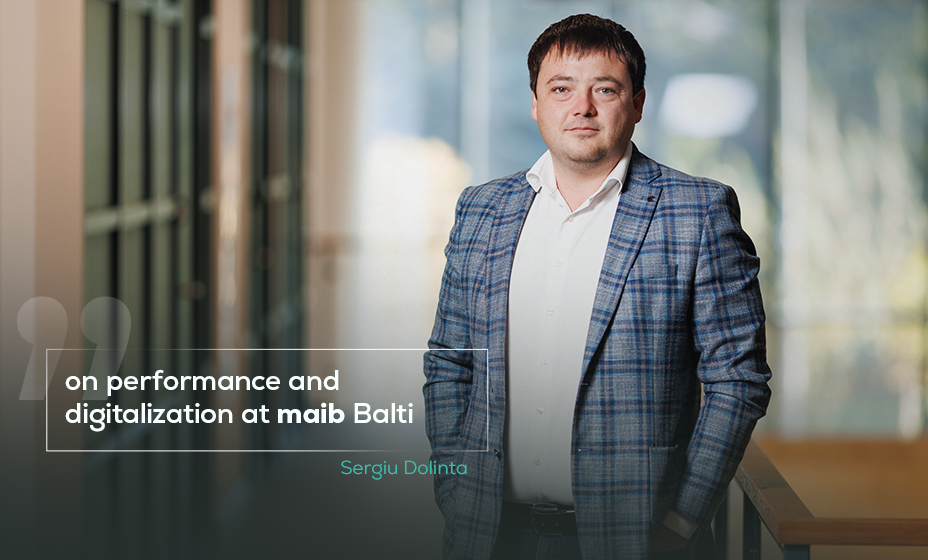
Sergiu, my first question is based on a personal observation.
Many years ago, I also worked in a bank and personally knew many branch managers in Chișinău and across Moldova. At some point, I had the impression that years were passing, managers were simply getting older, but not really changing. In recent years, however, many things have changed. Today, there are veteran managers with decades of experience, as well as directors who have only recently taken over branch leadership. Which category do you belong to?
I can certainly be considered part of the younger generation of banking leaders. I have been working in the banking sector for ten years, but I took over the position of Director of the maib Pușkin Branch in Bălți in October 2025.
Before that, had you also worked in Bălți?
Yes. I have a classic career path, starting from the most junior positions within the branch. I had the opportunity to experience almost every role in the bank firsthand. My journey in the banking system began in 2015, working with corporate clients. At that time, the position was called Account Service Specialist.
In this case, you can certainly answer the question: what changes have taken place over the past ten years?
The first obvious change is that bank employees have become much more versatile. Today, the required set of skills goes far beyond purely banking competencies. An employee must also be a good psychologist for the client, a salesperson, and able to understand statistics. At the same time, we must consider that many tasks that previously required a lot of time at the counter are now digitalized. This frees up time for communication with clients, and in that communication, one must perform at a high level in every respect.
So, does versatility replace specialization?
I believe this is an inevitable process. When I first started working, each of us had a very clearly defined area of responsibility. You mastered a very narrow field, such as analyzing a company’s financial indicators. Today, every branch employee understands many more aspects of the business, and the professional outlook has become much broader.
Has the number of employees in branches increased, given that the number of clients continues to grow?
Productivity has increased, not headcount. I cannot say exactly how many people worked in the branch in 2015 compared to 2025, but overall, the number of employees has remained approximately the same, while the number of clients has increased by at least 50%. We can therefore speak about a completely different level of efficiency, and one of the most important factors behind this is the pace of digitalization of the banking business—especially in a bank like maib.
I recall an amusing detail. When I attended my job interview at maib ten years ago, right here in Bălți, a colleague from Chișinău asked me whether I had a bank card. I honestly answered that I did not. At that time, there was no real need for one. Today, we can clearly see how much things have changed: a significant number of clients now open accounts without visiting the bank, not to mention loans granted directly to cards, without spending hours in a branch. I am proud to work for a bank that is an undisputed leader in Moldova in terms of the pace of digitalization.
When it comes to consumer loans, approximately 70% are already granted online. Clients come to the bank only in situations where a more in-depth analysis is required. Communication with clients remains essential, as it is otherwise difficult to fully understand their needs. In the future, however, I believe this interaction will increasingly shift toward customer surveys and organized meetings that are beneficial both for the bank and for clients.
It is interesting to imagine the scale of the branch you manage, in order to compare it with those in Chișinău…
The maib Pușkin Branch in Bălți is large for a regional unit. We serve 2,400 legal entities and over 60,000 individual clients.
Impressive figures.
That is why, in addition to the main branch, we also operate three agencies in the city, where we provide the full range of banking services—from deposits and loans to corporate client servicing.
When I worked in banking, there was a significant difference between branches in Chișinău and those in the regions. How do things stand today? Do these differences still exist?
In this respect, the changes have been radical. The maib branch network is fully unified and operates at a single standard. The advisory services and customer experience are identical in Chișinău, Comrat, Cahul, or Bălți. You are probably a maib alto client?
Yes.
Then, when you are in Bălți, I invite you to visit our maib alto area. We have two premium relationship managers working there, and you will only realize that you are not in Chișinău when you step outside the branch onto the streets of Bălți.
Since we are talking about regional specifics, I would like to ask about Bălți as an economic region of Moldova. What sets it apart?
When discussing the economic profile of Bălți, we cannot overlook the automotive sector enterprises, specialized in the production of wiring systems and electronic components, which are residents of the Bălți Free Economic Zone. These are major players that have successfully navigated the difficult period in the European automotive industry, have stable orders, and continue to serve as the driving force behind the city’s industrial development.
And in other sectors of the economy?
I would mention the development of the IT sector, including IT park residents that are physically located in Bălți. Another important niche is the food industry, and I believe our companies are visible at the national level as well.
When we talk about investments, we often refer to foreign investments in Moldova. If we were to speak about domestic investments—from the capital to the regions—which sectors would you recommend for Bălți?
I would point to the social sphere, where there are still underdeveloped niches—from leisure and recreational activities to public catering.
What is the current population of Bălți?
According to various sources, between 95,000 and 115,000 inhabitants. We should rely not only on census data from Bălți itself, but also consider that residents from nearby localities and from across northern Moldova frequently come to the city.
To conclude, let us return to the bank. What are the main objectives of the branch in the near future?
I would highlight two key objectives. The first is expanding our client base—we still have growth potential and can continue increasing our market share. The second objective is digitalization. This requires very close communication with clients, and I would even say client education, so that they can fully benefit from the advantages of digital solutions.
We have talked a lot about work, but maintaining a balance between professional and personal life is important. What are your personal plans or passions?
It is quite simple: I have two dreams. One has a high chance of coming true, while the other has a lower probability, but I would still like to achieve it.
They say that voicing a dream is already a step toward making it come true. What are these dreams?
The first is to obtain a license to operate a sailing yacht. The first time I visited Croatia and saw the multitude of islands, I immediately wanted to return, rent a yacht, and take the helm.
A beautiful plan. And the second dream?
To learn how to pilot a light aircraft. In Bălți, we have two airfields, and I am convinced that general aviation will develop rapidly in Moldova. I would like, one day, to see Moldova more often from above.
All that remains is to wish that both of these dreams come true.