


 maibank
 maib business app
 new internet banking - maib business
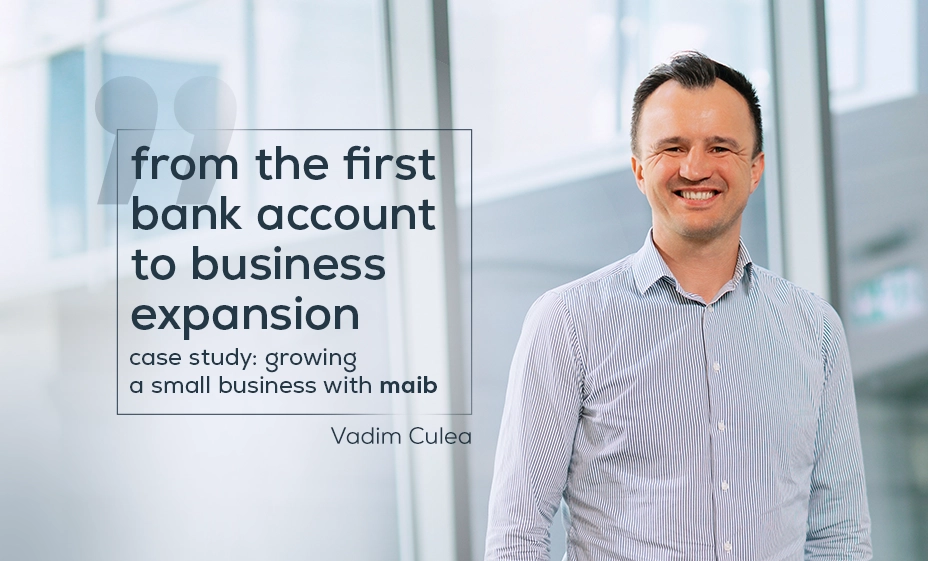
Interview with Vadim Culea, Head of Sales Department, Business Banking, maib
Introduction
Every good business textbook includes case studies. And for good reason. Reading information presented in theory is one thing; working through a real situation and putting yourself in the protagonist’s shoes is something else entirely.
That is why, when I met with Vadim Culea, Head of Sales Department, Business Banking at maib, to discuss how the bank supports a company’s growth from its very first day, we decided not to simply list maib’s products and services. Instead, we chose to illustrate this journey through a case study inspired by real-life relationships between the bank and its clients.
Knowing my passion for coffee, Vadim suggested that our case should be about a coffee shop, owned by an entrepreneur named Ana. Coincidence or not, that is also my daughter’s name.
So, if you are thinking of starting your own business or have already taken your first steps into entrepreneurship, read this interview.
Interview
Vadim, good afternoon. Let’s imagine how a newly established coffee shop and its owner interact with maib from the very first days after the business is set up.
If we talk about our philosophy, we want to be there for Ana right from the start. Not to pitch her a banking product straight away, but to help her deal with the things that eat up her time and distract her from running and growing her business.
For example, Ana knows she needs to register a company and set up its accounting. But she doesn’t have her own accountant and doesn’t know who to turn to.
Maib has partnerships with accounting firms, so we can recommend a trusted partner. The quality of the service matters to us. If we see that a partner does not deliver the level of service we expect for our clients, we end the partnership.
That way, Ana doesn’t waste time looking for an accountant. She can focus on her coffee shop while we help solve one of the first challenges that comes with launching a business.
The company has been registered, and the accountant is in place. The next step is opening a business account, and sometimes even several accounts.
Our goal is the same: for the entrepreneurs to spend as little time as possible on administrative tasks.
Today, to onboard with maib, Ana only needs to come to the bank once with the required documents. In the future, we plan to move to fully remote onboarding.
Once Ana becomes a client and installs our maib business app, she can do many things on her own. For example, she can open an additional account whenever it suits her, in the evening or even on weekends, without having to visit a branch again.
The coffee shop has opened. Today, most customers pay by phone or card, which means the question of accepting cashless payments also has to be sorted out.
Exactly. The natural next step is installing a POS terminal.
Today, roughly 43% of the POS terminals on the market are operated by maib. Our goal is to install the terminal as quickly as possible after the client requests it, usually within two to three days.
But these days we don’t just handle the technical side of processing cashless payments. Through our mobile application, maib business, which is becoming an everyday assistant for entrepreneurs, a genuine database about the business gradually takes shape.
Ana can access detailed statistics, including the number of customers she served, how much they spent, what times they came in, and how many of them were returning customers.
In other words, payments aren’t just transactions; they’re also a valuable source of information about how the business is doing. Merchant Portal, a module within maib business platform, helps by providing detailed analytics on transactions conducted through POS terminals.
Now let’s assume Ana decides not to stop at the coffee shop. For example, she also has a line of pastry products that she would also like to sell online.
In that case, the next step is connecting e-commerce solutions and enabling her to accept online payments.
As a business grows, its banking needs evolve as well. Our role is to grow alongside the client and provide the right tools at every stage of development.
For reference, maib’s current market share for POS and e-commerce services is around 44%.
If, for retail customers, maib has made it possible to do almost everything in the maibank app, saving a lot of time, how do things stand for entrepreneurs?
At the early stages of a business, entrepreneurs often handle almost everything themselves. Ana might have one or two employees, some working part-time, while she herself spends part of the day behind the counter. Her priority should be running and growing the coffee shop, not dealing with banking operations.
That is why we developed maib business, our internet and mobile banking solution for businesses. Through it, Ana can make payments remotely, including from her mobile phone, not only during standard banking hours but also after work or on weekends.
An important advantage is that transfers between maib clients are processed 24/7. Today, every second company in Moldova is a maib client. This means that if one of your business partners, who is also a maib client, transfers money to you on a Saturday, and you need to top up your business card account for a business trip on Sunday, you can do it without any restrictions.
It is no coincidence that 53% of newly established companies choose to open their accounts with maib.
On lending and financing the early stages of growth
We’ve talked about payments and day-to-day operations. What happens when Ana needs financing to grow? Let’s say she wants to buy additional equipment, but doesn’t have enough of her own funds.
I agree that financing is often one of the biggest challenges for young businesses.
A company may have been operating for only three months, with very little financial history, while growth opportunities require funding today.
That’s why we’ve started financing start-ups.
At this stage, we are not talking about large amounts. Ana can get up to EUR 2,000 without collateral through a credit card and use that money to grow her business.
From there, we keep an eye on how the company evolves. If the business operates steadily, repays its debt properly, and demonstrates healthy growth, we do not necessarily have to wait 12 months before considering additional financing.
After a few months, we can revisit her case and reassess the financing amount. In other words, as Ana’s business history grows, so do the financing opportunities available to her through maib.
Business payments in instalment
On top of that, we have another innovative solution for entrepreneurs like Ana.
During day-to-day operations, unexpected expenses can arise at any time: buying supplies, repairing a coffee machine, or covering other urgent business needs that call for extra funds.
We offer the option of identifying payments previously made from their maib account using the company’s own funds and later replacing them with financing provided by the bank.
In practice, Ana opens the maib business app, selects a payment she made earlier, and converts it into a payment in instalments. As a result, the full amount of that payment is returned to the company’s account and can be used for a new investment or other business needs.
This product is called “business payments in instalments”, and one of its main advantages is that it’s available even to newly established companies.
The first year in business and the opportunities that follow
So, in the first year of operation, an entrepreneur can count on unsecured financing of up to EUR 2,000?
We take an individual approach with each client.
After two, three or four months, we can revisit the situation and review the financing terms. That said, an important milestone is completing the first 12 months of operation.
By then, the business has built a sufficient track record, and access to most of our products becomes considerably easier.
I’d particularly like to highlight our business mortgage loans. While a standard investment loan usually runs for five to seven years, business mortgages can be granted for up to 12 years.
In other words, Ana could replace her rent payments with instalments on buying her own premises?
Exactly.
In many cases, mortgage instalments are comparable to the cost of rent. The difference is that, instead of paying for rented premises, the entrepreneur is investing in an asset of their own.
And we have to admit, that’s a completely different outlook.
Maib, a partner in business growth
Can we say this approach makes maib a true partner to the entrepreneur, not just a bank?
And not just a financial partner.
An entrepreneur has plenty of challenges to deal with: entering new markets, optimizing internal processes, building a team and much more. Maib aims to stay close to its clients across all of these.
We recently wrapped up maib export school, a programme for entrepreneurs in the Republic of Moldova. It’s part of the maib business school initiative, through which we run educational programmes and specialized events designed to address the challenges that come up as businesses grow.
We’re also now launching maib leadership school, in partnership with the EBRD and Human Invest, the official representative of Blanchard. The programme runs for two months, and maib clients can take part free of charge.
So, at some point, the bank starts supporting Ana not just financially, but also in her development as an entrepreneur and leader?
Our mission goes beyond providing banking products. If Ana’s business grows, at some point she has to grow as a manager and leader too. That’s the essence of our philosophy.
The entrepreneur remains the one who runs the business, makes the decisions and sets the direction. We strive to be by their side and give them the tools they need at every stage of growth.
Expanding the business and new financing opportunities
Once entrepreneurs really start to understand their business, the desire to expand follows. And that creates new financing needs, on a different level.
When we’re talking about a company that already has experience, a credit history and tangible business results, the financing options become significantly broader.
In our case, Ana can access various government programmes supporting the business environment through maib. If there’s a lending programme that includes a grant component and her business meets the eligibility criteria, we can help her obtain that financing.
There’s also the 373 programme, which offers favourable terms and fixed interest rates.
But the most important thing isn’t whether a particular financial product exists. Ana knows very well how to run a coffee shop, but she doesn’t have to be a finance expert or know every programme on the market.
Our role is to analyse her business situation and recommend the most suitable financing solution for the stage she’s at.
What happens if the business doesn’t have enough collateral?
If a company lacks the necessary collateral, what options are there?
That doesn’t necessarily mean financing will be turned down.
We have access to external guarantee mechanisms, including through the DFC, the EBRD, ODA and others. If the company’s own collateral isn’t sufficient, in certain situations we can supplement the application with one of these external guarantees, which allows us to increase the amount available for financing.
The cost of such a guarantee depends on the instrument used and typically ranges from 0.5% to 1% a year.
The entrepreneur should focus on the business
Can we say that the whole philosophy behind the relationship between the bank and the entrepreneur rests on the idea that the entrepreneur should focus on their business, while the bank helps them choose the right financial tools?
That’s exactly the principle.
The goal of Ana, around whom we built this case study, is to keep her coffee shop running smoothly and growing. Everything else is secondary.
The less time an entrepreneur spends dealing with side issues, the more time they have for their core business.
But we don’t just aim to save her time. We also think about how we can help her grow faster. And it’s not only about financing or education.
Partnerships that support business growth
Are there other ways the bank can contribute to a business’s growth?
Yes. Let’s say Ana comes to us with a specific idea. For example, she’s created a special menu for employees of IT companies and proposes developing a partnership programme. The clients get special terms, and she gets the chance to promote her products to a new audience.
For projects like this, we’ve set up a team dedicated to developing partnerships. Its role is to constantly identify and create new opportunities for collaboration.
If Ana comes to us with an idea we haven’t implemented before, we don’t want to tell her, “We don’t have a product like that.” On the contrary, we’re ready to explore together how such an initiative could be built.
We already have partnership programmes in various areas, including for purchasing agricultural equipment or computer hardware, but we’re also open to completely new formats.
Vadim, throughout this interview we’ve looked at the entire journey of an entrepreneur just starting out. Still, an interview isn’t a practical guide. What should an entrepreneur do if they see opportunities in these examples that are relevant to their own business and want to make the most of them?
They should come to maib with their business and their goals.
The bank has 35 years of experience working with entrepreneurs, and over that time we’ve been part of hundreds of thousands of business stories and situations.
We can look at each case individually, understand the stage the company is at, and work out together the right solutions for today and for future growth.
The entrepreneur knows their business better than anyone else. We know the financial and banking side, and we’ve seen how other companies have travelled a similar path.
That’s why we want entrepreneurs, at every stage of growth, to be able to focus on their business, confident that they have a partner by their side who puts them at the centre and is always ready to help when needed.